BackExplainer: The legals for placements

THE LEGALS FOR PLACEMENTS IN A NUTSHELL
In most countries:
- The placement provider (i.e. the employer) has primary responsibility for the health and safety of the student;
- The school's/college's role is solely to take reasonable steps to satisfy themselves that the employer is acting responsibly;
- For Health & Safety and insurance purposes, young people on placements are considered like normal employees of the host, so a company’s normal Risk Assessment (RA), Health & Safety (HS) and insurance policies are sufficient. The employer just needs to make sure that what they have in place is appropriate for the age of the people hosted on the placement. For example, the RA and H&S policies need to take into account young people who might not be familiar with workplaces.
- Parents/caregivers of students under 18 need to agree to the student going on a placement.
SOME COMMON PLACEMENTS MYTHS
Over the years an industry has developed of third parties that charge schools to support them with their work experience programmes. Some of these organisations claim the following things - which are not true:
- You need a specialist qualification to sign off on a work experience placement
- All - or the majority - of work experience placements have to be visited
- By not using a third party, a school is somehow putting itself or its students at risk
- If a placement lasts longer than 3 days, the employer must have a DBS check
On the other hand, some work experience coordinators wrongly believe that if an employer doesn't have the relevant documentation, or if it's a take-your-child-to-work day, parents can sign a waiver which means that it's okay for the student to go on the work experience. No such magic waivers exist! We explain more below.
KEEP CALM, AND RUN A PLACEMENTS PROGRAMME!
Historically some schools/colleges have been put off from running in person placement programmes because they have been too worried about taking the blame if something goes wrong on a placement. This is a big shame, and shouldn't happen! The main reason we have created our Placements tool is to make it easy for schools to carry out their legal duty to take reasonable steps to ensure that the employer will provide a safe placement.
The Unifrog Placements tool is essentially a series of forms that lets schools / colleges check that the employer has the necessary insurance and policies in place. It also gives employers guidance to help them run a great placement, and to make sure that their insurance and policies are all appropriate, and it makes it easy for a parent/caregiver to agree to the placement.
Note: This guide is particularly based on UK law. Most countries have similar rules in place, but if you’re involved in a placement outside of the UK, check the local law. For placements not in the UK, we handle the Insurance, Health & Safety, and Risk Assessment sections differently from placements in the UK - for example rather than asking for the Employers' Liability Insurance certificate, we ask for detail on how the placement is insured.
CRIMINAL RECORDS CHECKS
THE RULES FOR CRIMINAL RECORDS CHECKS
When does an EMPLOYER hosting a placement need to have a criminal records check (e.g. a DBS check)?
Schools/colleges must not allow a person on the Children's Barred list to take part in ‘regulated activity’, and an Enhanced DBS check with Children's Barred list is used to find out if someone is on the Barred list. When it comes to work experience, regulated activity means supervising a placement where the student is below 16 and one of the following applies:- The placement is overnight
- The person providing the supervision will be doing this for more than 3 days over a month-long period (even if it's across multiple placements with different students)
The definition of ‘regulated activity’ is not related to the length of a placement, but to the frequency with which the supervisor is involved in placements in general. For example a 5-day placement where there is a different supervisor each day, and these supervisors are only involved in placements once a year, does not constitute ‘regulated activity’. On the other hand, a 1-day placement may be regulated activity, if the placement's supervisor is in charge of many such placements each month.
In practice, it is not always easy to determine what placements qualify as regulated activity, and even an employer might find it hard to know if their employee satisfies the frequency criteria. But most traditional forms of work experience (a 5-day placement where the same person supervises the student all along) will likely qualify, if the student is below 16.
The law states that a school/college must not allow someone on the Barred list to take part in regulated activity. Requesting DBS checks for the supervisor in every placement that qualifies as regulated activity allows you to be certain you fulfil this legal requirement, but is not in itself legally required.For placements where the student is 16+, the school/college cannot request a DBS check of the employer.
You can review the guidance in KCSIE 2026 (from paragraph 406).
When does a STUDENT need to have a criminal records check (e.g. a DBS check)?
If a student doing a placement is 16 or above and the placement is in a ‘specified place’ (eg a school) or involves contact with children or vulnerable people, then the employer may require the young person to have a criminal records check - it is at the employer's discretion.It's not possible for someone under the age of 16 to have a DBS check.
It's best practice to make the whole placements process as straightforward as possible, so employers shouldn't require a student to undergo a criminal records check (which can take a lot of effort and some expense) unless it's really necessary.
THE PLACEMENTS TOOL AND CRIMINAL RECORDS CHECKS
On the Placements tool, when it comes to whether the employer needs to have a criminal records check:
- If the student is below 16, we ask the employer if:
- The placement will take place overnight
- The placement supervisor does frequent supervision of work experience (more than 3 days in a month-long period)
These two fields check if a work experience placement falls under the status of ‘regulated activity’. If the employer answers yes to either of these, we also ask them whether they have checked that supervising adults are not barred from working with children, and explain that this normally means that they have had a DBS check.
As a teacher, you can see the employer's answer to each of these fields, and make a decision about whether to give the placement permission, and whether or not to request a DBS check.
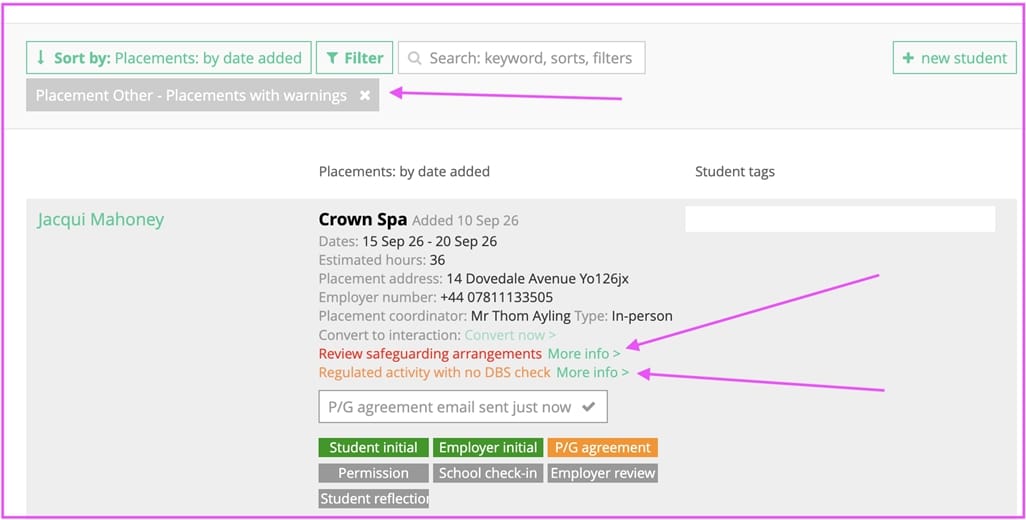
To make things easy, if a placement is a regulated activity, and the employer has not done an official check, the system flags this fact to teachers on the summary of the placement, and where the placement appears on the Advanced view of the Manage page.
- If the student is below 16, we ask the employer if:
- Separately, we ask, for students of all ages, whether the student is likely to spend significant time alone with the supervisor. We also asks the overnight question for students age 16 and above. These questions are not relevant for determining whether a placement qualifies as 'regulated activity', but we have included them for the following reasons:
- If an employer indicates that the students will spend significant time alone with their supervisor, we advise them that this is not best practice.
- The two questions serve to identify placements where a student will be in a non-standard situation, so you can be aware and monitor them especially if you think it necessary.
Again, to make things easy for teachers, if the student will spend significant time on their own with the supervisor, or if the placement will take place overnight, the tool shows a warning both on the summary of the placement, and where the placement appears on the Advanced view of the Manage page.
- Here is how the ‘Regulated activity without DBS’ and the ‘Safeguarding’ warnings look on the Advanced view of the Manage page. There is a filter for ‘Placements with warnings’, which filters for only these placements, as well as ones where the employer has said they'll email their insurance / Health & Safety / Risk Assessment documents later, or where they've said they don't have these documents.
- When it comes to whether the student needs to have a criminal records check, we give the employer the ability to require that the student does a check, including specifying what check needs to be done, and how. This ability is not given if the student is under 16.

SAFEGUARDING
THE RULES FOR SAFEGUARDING
In the context of work placements, ‘safeguarding’ means keeping young people safe from physical, emotional or sexual abuse during the placement, and also for the employer to follow best practice in flagging concerns they might have that a young person is being abused, or is at risk of being abused.
It's good practice for schools/colleges to give the employer information about how safeguarding concerns should be dealt with during the period of the placement, including sharing with the employer the contact details of the designated safeguarding person. If you're using our Placements tool, we give this information to employers on the Employer initial form.
Here's some more safeguarding best practice during placements:
- The Employer placement lead (and whoever else is directly interacting with the young person on the placement) should be mature in their attitudes and able to establish good professional relationships with young people;
- Physical contact should be avoided where possible, with the understanding that sometimes it is unavoidable, for example when it is necessary to show someone how to operate machinery;
- If a student doesn't show up to their placement, or they have an accident during the placement, or the student commits a significant act of indiscipline, you must let the School placement coordinator know right away;
- If a young person confides to an adult personal information that gives rise to concern for the young person's safety or the safety of others, the adult should:
- Be open to listening and be non-judgemental;
- Not promise to keep anything secret;
- Write down what the young person said in as much detail as they can, and as soon as possible pass on the information to the School placement coordinator.
THE PLACEMENTS TOOL AND SAFEGUARDING
On the Unifrog Placements tool, the Employer placement lead is shown the school's safeguarding policy, including how to raise a safeguarding concern with the school / college.
WORKPLACE VISITS AND CHECK-INS
THE RULES FOR WORKPLACE VISITS AND CHECK-INS
- Does someone from the school/college, or an external organisation hired by them, need to visit the workplace?
The short answer is that in-person checks are only necessary in unusual cases.
Unfortunately there is some confusion about this - with incorrect information sometimes being shared, often by third party organisations, who mislead schools in order to gain business for themselves.
The school/college's responsibility is to take reasonable steps to assure themselves that the employer is acting responsibly, and that the student will therefore be safe during the placement. If you follow the standard steps on the Unifrog placements tool (doing things like finding out from the employer what the workplace is like, what the overview of the placement is, and checking that they have a RA and H&S policy), then for most employers and their workplaces, and for most students, it is not necessary for someone to do an in-person check ahead of a placement happening, or during the placement.
Someone coordinating placements at a school/college might decide that an in-person check is necessary if the specific workplace, or the specific student, make them think that this would be a good idea (for example, the workplace might involve heavy machinery, or the student might have special needs).
There is no rule that for placements involving students below 16 there should be an in-person check, though you should of course take into account the student's maturity in your overall assessment of the risks involved in the placement.
- Do you need specific training to do a workplace inspection / check-in?
No specific training is required to do a workplace inspection / check-in. Health & Safety and Safeguarding specific training does of course exist, but for an employer to write a Health & Safety policy, or for a member of school/college staff to do a workplace inspection or check-in, no special training is required at all.
THE PLACEMENTS TOOL AND WORKPLACE VISITS AND CHECK-INS
On the Unifrog placements tool, any teacher can record an check-in, using the dedicated form for this. Teachers can record up to five check-ins per placement.
INSURANCE
THE RULES FOR INSURANCE
- What type of insurance is needed for placements?
When people talk about the insurance that is required for placements, they are (or should be!) talking about Employers' Liability Insurance (ELI). This financially safeguards an employer against allegations of injury or illness to employees arising out of their employment, and in so doing it also safeguards employees, because it means that there will be money available should the employee make a successful claim. With a few edge-case exceptions (detailed below), it is a legal requirement for any employer.
In the UK and in many other countries, students on a placement are treated as employees of the employer for the purposes of insurance - so it's important that the employer has ELI in place.
Separately, the employer may have a Public Liability insurance policy, which (regardless of what people might tell you) is not a legal requirement to host work placements, and it will not cover students themselves when they are at the placement. Nonetheless, most Public Liability policies will cover any accidental injury or damage to third party property arising from the actions of a student on work experience, and many employers want to make sure that they are insured in this way. If this is the case they should check their Public Liability insurance policy document, and if they are in doubt, they should contact their insurer or the broker who arranged the policy.
- Does all Employers' Liability Insurance cover students on placements?
If the student will be working for the employer for longer than 2 weeks, normally employers need to notify their insurer about the placement.
The employer should also check whether the Employers' Liability Insurance covers young people who are less familiar with workplaces:- In the UK, a normal Employers' Liability Insurance policy will cover work placements provided the insurer is a member of the Association of British Insurers (ABI), or Lloyds, so there is no need for additional Employers' Liability Insurance
- The employer should check their policy documentation to ensure that they are adequately covered; when in doubt, they should contact their insurer or the broker who arranged the policy.
- Does the employer who is hosting a placement need to provide a copy of their Employers' Liability Insurance certificate?
Yes - if they have ELI, even for a normal low risk placement, the UK's Health & Safety Executive recommends that schools / colleges see a copy of the employer's insurance certificate.
- When might a placement host be exempt from needing Employers' Liability Insurance?
In the UK these sorts of employers are exempt from needing Employers' Liability Insurance:- Sole traders, and companies employing only their owner where that employee also owns 50% or more of the issued share capital in the company;
- Most public organisations including government departments and agencies, local authorities, police authorities and nationalised industries;
- Health service bodies, including National Health Service trusts, health authorities, primary care trusts and Scottish health boards;
- Some other organisations which are financed through public funds, such as passenger transport executives and magistrates’ courts committees;
- Family businesses, i.e. if all of your employees are closely related to you (as husband, wife, civil partner, father, mother, grandfather, grandmother, stepfather, stepmother, son, daughter, grandson, granddaughter, stepson, stepdaughter, brother, sister, half-brother or half-sister). However, this exemption does not apply to family businesses which are incorporated as limited companies.
- More detail on sole traders and Employers' Liability Insurance:
- A sole trader does not have a legal obligation to have ELI, including when they host someone on work experience.
- Despite the fact that it's not a legal obligation, the ABI and individual insurers tend to advise sole traders to take out ELI when they host a student on work experience - obviously the ABI and insurers have a vested interest in advising people to take out insurance!
- Schools / colleges could decide that a sole trader must have ELI to host work experience, but they need to balance this against putting up unnecessary hurdles to students going on work experience, and they should also remember that the risk in not having this insurance actually lies with the sole trader rather than with them.
- A limited company that only employs one person does legally need to have ELI, unless that one person also owns 50% or more of the issued share capital. So a typical single-director company - where that director is the sole worker and owns the whole company - is exempt.
THE PLACEMENTS TOOL AND INSURANCE
On the Unifrog Placements tool, for an in-person placement:
- In the Employer initial form (the first form an employer needs to complete as part of organising a placement) the tool asks employers to give details for their Employers' Liability Insurance, including uploading into the form a copy of their insurance certificate.
- If an employer is unable to upload into the form a copy of their ELI certificate (for example they are blocked from doing it by an employer's firewall, or the employer considers that the insurance certificate is confidential), then the employer can use the ‘Problem uploading’ element in the form to say that they can't provide the document that has been asked for, and explain their reasons. They can, for example, email their certificate to the placement coordinator instead of uploading it into the form.
- If the Employers' Liability Insurance will have expired before the end date of the placement (or a day after the start date if the placement is marked as ‘ongoing’), then the Employer placement lead must commit to updating the insurance details when the existing insurance expires. The placements tool automatically sends the employer a reminder email to update their insurance details on the day after the employer has said that their insurance will expire.
- If the employer fits into one of the special categories of organisation that is exempt from needing Employers' liability Insurance (the categories are listed above), the tool asks the Employer placement lead what insurance, if any, the employer does have in place.
RISK ASSESSMENTS
THE RULES FOR RISK ASSESSMENTS
- What has to be covered in a Risk Assessment?
In a Risk Assessment (sometimes referred to as an ‘RA’), an employer must:
- Identify what in the business could cause injury or illness (the hazards);
- Decide how likely it is that someone could be harmed and how seriously (the risk);
- Explain how the employer minimises the hazards, and how they control the risks.
- Does a Risk Assessment have to be written down?
In the UK companies with fewer than 5 employees don't legally need to have a written Risk Assessment, though we think it's good practice to have one. And even though it doesn't legally need to be written down, an employer should still have gone through the process of assessing risks, and considering what steps to take to mitigate the risks you identify.
- Who is responsible for the Risk Assessment? Does the student's school, college or parent need to sign it off?
It is wholly up to the employer to create a suitable Risk Assessment - they are the ones who are responsible for the wellbeing of their employees (including students on placements), and they are the ones who understand the risks encountered at their workplace. It's not the role of the school, parent/caregiver or student to ‘approve’ or ‘sign off’ on the Risk Assessment.
- Does an employer need to create a Risk Assessment specifically for hosting students on work experience?
When an employer is hosting a young person on a placement, they should check that their Risk Assessment sufficiently takes into account having a young person on site, who might be less familiar with workplaces. This doesn't mean that the Risk Assessment needs to specifically mention young people, but there might be additional risks or actions that you need to take to ensure that everyone at the workplace remains safe - and if so, the employer should update their organisation's Risk Assessment, or create one specifically for hosting a placement.
How often should an employer review their Risk Assessment?
There is no official rule on this, it's up to each employer to decide what they think is sensible, for example they might have a policy of reviewing it once a year, or when relevant circumstances change (e.g. moving into a new workplace).
What about at a large employer, or one with multiple sites, which has many different Risk Assessments?
A placement needs to have had the risk associated with it assessed, so the employer needs to decide if this is best done by using their existing Risk Assessments, or if they need to create a Risk Assessment specifically for the placement or placements they are going to be hosting.
- What should a Risk Assessment look like?
You don't have to do it like this, but we recommend that your Risk Assessment includes a simple table like this one, with a new row for each risk you identify:
| Hazard description | Who might be harmed and how? | What are you already doing to control the risks? | What further action do you need to take to control the risks? | Who needs to carry out the action? | When is the action needed by? |
| E.g. Slips and trips | E.g. Staff and visitors may be injured if they trip over objects or slip on spillages. | E.g. All areas well lit, including stairs. No trailing leads or cables. Staff keep work areas clear.
| E.g. Better housekeeping in staff kitchen needed, e.g. on spills. Arrange for loose carpet tile on second floor to be repaired/replaced. | E..g All staff, supervisors to monitor Manager to organise for carpet to be repaired. | E.g. Immediately |
---> Download a template Risk Assessment here.
To help you with your own, here's an example we've filled in for an imaginary car garage, and here's one for an imaginary office-based company.
THE UNIFROG PLACEMENTS TOOL AND RISK ASSESSMENTS
- When does the Placements tool ask for the employer to upload their Risk Assessment (RA) into the Employer initial form?
On the Unifrog Placements tool, out of an abundance of caution, if any of these apply for an in-person placement:
- The employer has never hosted a placement before
- The workplace represents above average risks
- The student has said that they have special needs, illnesses or injuries that might affect the placement
Then the employer is asked to upload a copy of their Risk Assessment into the form (if they are blocked from doing this by their organisation's firewall, the form allows for them to email it to the placement coordinator instead; the employer can also indicate that they cannot provide the document at all, in which case they have to explain themselves, and their explanation is shown to all other parties). The placement coordinator can choose to give permission for the placement to happen before receiving these documents - it's totally up to them. As we've already said, it's not the role of the school/college, parent/caregiver, or student to ‘approve’ or ‘sign off’ on the policy.
- What about if the employer cannot upload their Risk Assessment (RA) into the Employer initial form?
Some employers consider that their Risk Assessment is confidential, or for some other reason they cannot upload it into the Employer initial form (for example, the company's firewall might block our uploader).
In this case, in the Employer initial form an employer can use the ‘Problem uploading’ element to say that they can't provide a document that has been asked for, and explain their reasons. They can also choose to email the Risk Assessment to the Placement coordinator instead.
FIRE RISK ASSESSMENTS
THE RULES FOR FIRE RISK ASSESSMENTS
In England, workplaces and business premises (except for single-family private homes), regardless of the number of employees, must have a Fire Risk Assessment. If there are fewer than 5 employees it doesn't necessarily need to be written down, though all the same it's a good idea to have it in writing. Wales, Scotland and Northern Ireland have similar requirements.
The responsibility for the Fire Risk Assessment might be the landlord's, but in many cases it is also the responsibility of the employer that uses the workplace.
An excellent source of best practice on Fire Risk Assessments is this page on the government's website. It includes guides specific to different sorts of workplaces.
Find the UK government's simple Fire Risk Assessment checklist here.
THE PLACEMENTS TOOL AND FIRE RISK ASSESSMENTS
On the Unifrog Placements tool, on the Employer initial form, we ask the employer to confirm that their organisation follows the Fire Risk Assessment rules for England.
HEALTH & SAFETY POLICIES
THE RULES FOR HEALTH & SAFETY POLICIES
- What is a Health & Safety policy?
An employer's Health & Safety (sometimes called ‘H&S policy’) explains how the employer manages health and safety in their business. It should lay out who does what, when and how.
A Risk Assessment forms part of a Health & Safety Policy, but the H&S policy should cover other things as well, for example it should make clear who has overall responsibility for health and safety, and who has day-to-day responsibility for different things (this will be clearer if you look at our downloadable template below).
The employer might want to explicitly detail how health and safety will be managed on work experience placements, for example laying down the rules of what a student can do during a placement, explaining who will be responsible for them from a health and safety perspective, and covering logistics like the policy of doing a health and safety briefing with students on their first day.
- Who is responsible for creating the Health & Safety policy?
Just like with Risk Assessments, it is wholly up to the employer to write a suitable Health & Safety policy - they are the ones who are responsible for the wellbeing of their employees (including students on placements), and they are the ones who understand the risks encountered at their workplace. It's not the role of the school, parent/caregiver or student to ‘approve’ or ‘sign off’ on the policy.
- Does a Health & Safety policy need to be written down?
Just like with Risk Assessments, in the UK companies with fewer than 5 employees don't legally need to have a written Health & Safety policy, but we think it's good practice to have one. And even though it doesn't legally need to be written down, an employer should still have gone through the process of creating a Health & Safety policy, including making clear who does what, when, and how when it comes to health and safety.
- What about large employers, or ones with multiple sites, which have many Health & Safety policies? And what about if the Health & Safety policy is confidential?
Just like with Risk Assessments:- An employer needs to have a Health & Safety policy that properly accounts for any placement that they are hosting. It is for the employer to decide if their existing policy or policies suffice, and if not they need to adjust an existing one or create a new one.
- In most cases Health & Safety policies can be shared with a school or college when asked for, but if this is not possible, the employer can indicate this in the Employer initial form (the first form that an employer completes as part of organising a placement on Unifrog), using the ‘Problem uploading’ element.
---> To help you create your own, download a template Health & Safety policy here.
THE PLACEMENTS TOOL AND HEALTH & SAFETY POLICIES
- When does the Placements tool ask for the employer to upload their Health & Safety policy (H&S policy) into the Employer initial form?
On the Unifrog Placements tool, out of an abundance of caution, if any of these apply for an in-person placement:
- The employer has never hosted a placement before
- The workplace represents above average risks
- The student has said that they have special needs, illnesses or injuries that might affect the placement
Then just like for Risk Assessments, the tool instructs the Employer placement lead to upload a copy of their Health & Safety policy into the form.
- What about if the employer cannot upload their Health & Safety policy into the Employer initial form?
Some employers consider that their Health & Safety policy is confidential, or for some other reason they cannot upload it into the Employer initial form (for example, the company's firewall might block our uploader).
In this case, in the Employer initial form an employer can use the ‘Problem uploading’ element to say that they can't provide a document that has been asked for, and explain their reasons. They can also choose to email the H&S policy to the Placement coordinator instead.
GDPR AND RELATED DATA PROTECTION LAW
THE RULES FOR GDPR AND RELATED DATA PROTECTION LAW
In most countries data protection and privacy laws are very detailed, but common themes are that:
- Data must be held securely;
- You should only use and store the minimum amount of data necessary;
- Only people who really need to see the data should be able to see it;
- The data subject should always give permission for their data to be used and stored;
- The data subject should be able to take away their permission when they wish to.
THE PLACEMENTS TOOL AND GDPR AND RELATED DATA PROTECTION LAW
To host a placement via Unifrog you must abide by the relevant data protection and privacy laws in place in the placement country. You can research these on the relevant official websites, for example ICO in the UK.
On the Unifrog Placements tool, the Employer placement lead must agree to abide by the data protection law in place in the country where the placement is taking place.
WHEN A FAMILY MEMBER HOSTS A STUDENT FOR A PLACEMENT
WHAT DUTY OF CARE DOES THE SCHOOL/COLLEGE HAVE?
If a student is on a work placement with a family member (e.g. a parent/caregiver), and the placement is part of a school's / college's programme, or is directly encouraged by the school or college, then the school or college still has the same duty of care that they would if the student were doing a placement with anyone else.
The duty of care is to take reasonable steps to satisfy themselves that the host is acting responsibly - i.e. that the host has the appropriate insurance, Health & Safety policy and Risk Assessment in place. So in these cases, if you are using the Unifrog Placements tool, we very much recommend that the admin for the placement is run through the tool as normal.
Here are some of the confusing elements to do with family members hosting placements:
- Employers' Liability Insurance. Sometimes people think that if a family member is hosting a placement, there's no need for the employer to have Employers' Liability Insurance. It's true that in the UK, family businesses where all the employees are closely related don't need ELI - however, firstly this exemption does not apply to family businesses which are incorporated as limited companies, and secondly almost any other sort of company does need to have ELI, even if the host is a family member of the student.
- Health & Safety policy, Risk Assessment, Safeguarding. For these things, when a family member hosts a placement, there are no differences from any other type of placement, including when the placement is at a family business.
- If the placement is happening totally separate to the school or college (e.g. during a holiday, entirely separately from the school / college) then of course staff at the school or college do not have their normal duty of care to satisfy themselves that the employer is acting responsibly. What does 'totally separate' mean? The problem is that this is open to interpretation; let's say a school / college has an inset day and encourages students to do a day's work experience with a family member during their time off timetable - is that totally separate from the school or college? You could argue it either way. Out of an abundance of caution, we recommend that schools and colleges tell their students to run any placements they do through the normal administrative processes - and we've built the Unifrog Placements tool to be as straightforward as possible so that it doesn't put people off from taking the safe option.
CAN A PARENT AND/OR THE EMPLOYER SIGN A WAIVER IF THE EMPLOYER DOESN'T HAVE THE RELEVANT DOCUMENTS, OR IF IT'S A TAKE-YOUR-CHILD-TO-WORK DAY, OR IF THE PLACEMENT IS ABROAD, OR FOR ANY OTHER REASON?
No, there is no role for waivers, of any kind, in organising work experience placements. This is because students on work experience are considered employees under UK health and safety law, and:
- It is illegal for employers to use a contract or waiver to exclude or restrict their liability for death or personal injury resulting from negligence;
- A parent cannot sign away a child's fundamental statutory protections on their behalf.
CAN A STUDENT GO ON A PLACEMENT IF THE EMPLOYER DOESN'T HAVE SOME OR ALL OF THE PAPERWORK?
Whether a school/college can give permission for a student to go on a specific work experience is a judgement call for the school/college. There is no rule that says: without seeing a particular document (even when it's asked for by the Unifrog Placements tool), a work experience can't happen.
For work experience a school/college's role is to take reasonable steps to assure themselves that the employer is acting responsibly, and that the student will therefore be safe during the placement; the purpose of getting sight of paperwork is just to help the school/college with checking that the employer is acting responsibly. There are various legitimate reasons for why an employer might not have paperwork, and in addition the government guidance says that it's not the role of the school/college to ‘second guess’ or ‘sign off’ on particular documents.
On the other hand, if an employer can't or won't provide paperwork, and the school/college feel that this means they can't assure themselves that the employer is acting responsibly - it's fair enough for them to refuse permission for the placement to happen.
PLACEMENTS AND VOLUNTEERS / VOLUNTEERING
THE RULES REGARDING WHETHER VOLUNTEERS COUNT AS EMPLOYEES
This question is important because the rules on whether an employer needs to have Employers' Liability Insurance, and written RA and H&S policies, are affected by whether an organisation has employees, and how many it has (see above!)
Volunteers are considered employees for the purposes of insurance if they act like and are treated similarly to employees, for example if their expenses are paid, if they volunteer regularly and in a consistent way, and if they are provided by the organisation with materials and detailed direction in order to do their volunteering. If a volunteer has a contract then they should definitely be considered as an employee.
In some cases it will be very clear that a volunteer should be considered as an employee for the purposes of insurance and RA and H&S policies, and in other cases it will be a judgement call. An organisation should consider taking legal advice to help make the judgement call.
THE PLACEMENTS TOOL AND ORGANISATIONS THAT ONLY HAVE VOLUNTEERS
On the Unifrog Placements tool, on the Employer initial form, an employer can select that they have ‘0 employees (e.g. only volunteers)’. If an employer selects this option, we invite them to upload an Employers' Liability Insurance Certificate, though (as long as they provide an explanation) they can say that they don't have one. The system treats them the same as an organisation with employees when it comes to their Health & Safety Policy and Risk Assessment.