Explainer: Unifrog for primary schools: FAQs

****** Unifrog for primary schools is live and ready for you to use ******
If you'd like to have a demo, request one here and we’ll set up a meeting with you, or email our Primary School Partnerships Manager, Kai (kai@unifrog.org), or call us on +4420 3372 5991.
What is Unifrog?
Unifrog is an online platform that helps young people find the best opportunities for them after school. We work with more than 4,000 schools, which includes more than 60% of UK secondary schools.
Many years in the making, we have now launched Unifrog for primary schools!
Unifrog for primary schools is designed to be a one-stop-shop for Careers and PSHE for primary schools.
Here are your frequently asked questions about it, answered.
What's included in a subscription for Unifrog for primary schools?
If you subscribe to Unifrog as a primary school, you get five main things:
- Careers lesson pack
Engaging, plug-and-play lessons that make up a comprehensive spiral careers curriculum for primary school.
- PSHE lesson pack
Plug-and-play, comprehensive spiral PSHE curriculum from Year 1 upwards.
- Interactions tool
Centralised recording of all careers and PSHE activities (lessons, assemblies, school trips), as well as internal and external reporting.
- Careers library
Interactive profiles of career sectors, filterable by school subject, showing children the full range of exciting careers available to them, and challenging stereotypes to do with gender and socio-economic background.
- Parent accounts
Parents have their own Unifrog accounts. They can see upcoming parent webinars, parent guides, and interactions added for their children (excluding details added by teachers into the ‘Details’ field which students see, or the ‘Notes for teachers’ field).
What exactly is Unifrog’s Careers lesson pack?
42 fun lessons that cover all of the CDI learning aims and the PSHE Association objectives for careers. The spiral curriculum is:
- Plug-and-play: Easy to deliver with minimal prep time.
- Engaging: Interactive tasks empower children to become active learners.
- Whole-school: Resources for Early Years, Key Stage 1, and Key Stage 2.
The Career Development Institute (CDI) is the UK's professional body for career development.
What are the lessons in the Careers lesson pack like?
- For Early Years
- A story-based lesson PowerPoint for each CDI learning area, designed for 15 minute delivery.
- Optional printable stories and character illustrations.
- Continuous provision recommendations for each CDI learning area.

- For Key Stages 1 and 2
- A lesson PowerPoint for each CDI learning area for each year group, designed for 30 minute delivery.
- An optional accompanying worksheet for each lesson.
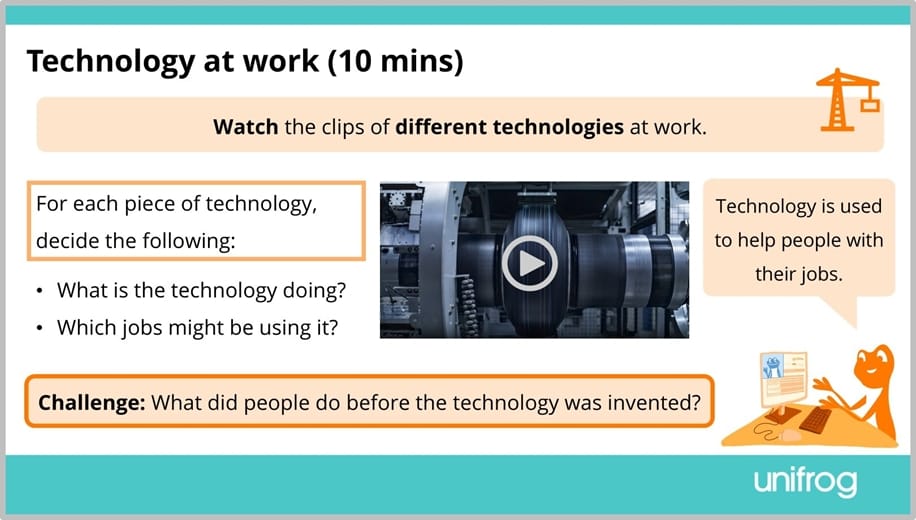


To find out more about the Careers Lesson Pack and download sample resources, click here.
What exactly is the primary PSHE lesson pack?
84 captivating lessons that fully cover the Department for Education RSE and health education learning objectives, as well as the PSHE Association learning objectives for children aged 5 to 11.
The comprehensive, spiral curriculum is:
- Plug-and-play: Easy to deliver with minimal prep time.
- Supportive: Detailed guidance allows you to deliver challenging topics confidently.
- Engaging: Interactive tasks empower children to become active learners.
The PSHE Association is the national body for PSHE education in the UK, recognised by the Department for Education and funded in part by government to provide guidance and evidence-based frameworks for schools.
What are the lessons in the PSHE pack like?
All lessons are designed for 60 minute delivery and consist of a ready-to-teach PowerPoint and optional accompanying worksheet.
There are also materials to support assessment, inspection, and sharing your PSHE curriculum with parents and caregivers, alongside a printable learning journey to display around your school.
To find out more about the PSHE Lesson Pack and download sample resources, click here.
What is the Interactions tool for primary?
Based on the Unifrog Interactions tool widely used in secondary schools in the UK, the Interactions tool for primary makes it easy for primary school teachers to record in one place every Careers and PSHE related activity - everything from lessons, to assemblies, to trips.
Quick for teachers to use, they can tag an activity by:
- TYPE
Eg is it a ‘Lesson / Workshop’ or a ‘1-1 interaction’
- WHO'S DELIVERING
Eg ‘Qualified adviser’ and/or ‘Parents’
- LEARNING
Eg ‘Careers’ and/or ‘PSHE’
- CAREERS FOCUS
Eg ‘Learning about the world of work’ and/or ‘Linking subjects and careers’
*** The Career focuses lead into the Gatsby Benchmarks that are widely used in secondary schools ***
- PSHE TOPIC
Eg ‘Health and wellbeing’ and/or ‘Relationships, families and friends’
The tool creates a comprehensive, inspection-ready record that's useful at the student, class and school-wide levels.
From an individual child's perspective, it's easy to see if someone is missing key activities, it's easy to port a child's recorded activities from primary to secondary, and it's easy to share what's been recorded with parents.
What is the Careers library for primary schools?
The Careers library is an interactive library of profiles of career sectors, filterable by school subject.
The profiles in the library feature video, engaging text, fun images, and accessible Labour Market Information.
The library is fully integrated with the lessons in the Careers and PSHE packs - delivering the lessons involves lots of exploring the library!
What are the learning aims of the Careers library?
The library is designed to help children explore a wide variety of job roles, and to understand what it’s like to actually do these jobs.
The library aims to:
- Challenge stereotypes about jobs
In particular stereotypes relating to gender and socio-economic background.
- Deepen children's engagement with school
Help children see the links between what they do at school, and the exciting possibilities of different careers ahead of them.

What are primary parent accounts?
Unifrog now has parent-specific Unifrog accounts, which allow parents to:
- See the interactions added for their children;
- Receive notifications from the school to do with Careers and PSHE;
- Browse the Careers library, and share content from it with their children;
- See and sign up to parent-specific webinars to do with Careers and PSHE run by Unifrog.
What's the use of parents having Unifrog accounts?
There's a lot of evidence that shows that young people's career and education aspirations are influenced by their parents, and that this is particularly the case for primary school aged children.
Unifrog parent accounts involves parents in a school's Careers and PSHE curriculum, and gives parents the information they need about Careers and PSHE to positively and knowledgeably support their children.
If my school subscribes to the platform, what support do I get from Unifrog?
We are very well known for our outstanding customer service. Here is exactly what support you get from your subscription:
- All staff have access to regular live virtual training
- You will be supported by a specific member of the Unifrog primary schools team:
- They will consult with you on how to best meet your aims for the platform during a goals meeting at the start of your subscription.
- They’ll also schedule a six-month review meeting to check on your progress and update your training.
- We reply to all emails within 24 hours (excluding weekends).
How much does a Unifrog for primary schools subscription cost?
The annual cost depends on the size of your school. The subscription comes with unlimited accounts for all your staff and parents, and includes access to all the Unifrog for primary tools, as well as our excellent training and customer service.
Please contact our Primary Schools Partnership Manager for a bespoke quote for your school: Kai (kai@unifrog.org). You can also give us a call on +4420 3372 5991.
Should we be teaching Careers and PSHE to primary school aged children anyway?
It might seem crazy to teach careers to students when they are so young - shouldn’t we just let kids be kids, without bringing the world of work into their young lives?
First and foremost, we think that careers education can be hugely fun - it can be about inspirational stories and exciting activities.
We also think that there are really important benefits to careers education for primary children: it can broaden children’s horizons about what jobs are available to them, and - through seeing the links between classwork and careers - it can fortify children’s engagement in school.
These are benefits that are available to all children, but they are particularly valuable for children from more disadvantaged backgrounds.
Careers education in primary schools: what does the evidence say?
- Broadening horizons
‘Dream Jobs’, a 2018 report by the OECD, found that by age 7, many children already start narrowing their career aspirations based on gender, social background, and stereotypes.
The report also found that early careers education helps broaden children’s views about “what’s possible”, especially for girls and children from disadvantaged backgrounds.
- Engagement in learning
‘Career-related learning in primary’, a 2019 report from the Gatsby Foundation, found that careers-related learning in primary can boost engagement in learning by helping children see a link between what they’re studying and “real life”.
What’s the best way to deliver careers learning for primary school children?
We’ve talked to expert primary school teachers, and studied the available literature, and we think these are the four key aspects of good careers learning at primary school:
- Embed careers learning in the curriculum (eg linking maths to being an architect)
- Use employers to challenge stereotypes (eg having a male nurse talk to students about his job)
- Activities that build transferable skills (eg learning how teamwork is useful in different jobs, then practicing it)
- Involve parents, whose influence is especially strong at this stage (eg parents learning with their children about different job roles and the routes into them)
We have tried to integrate these four key aspects into the design of Unifrog for primary schools.